


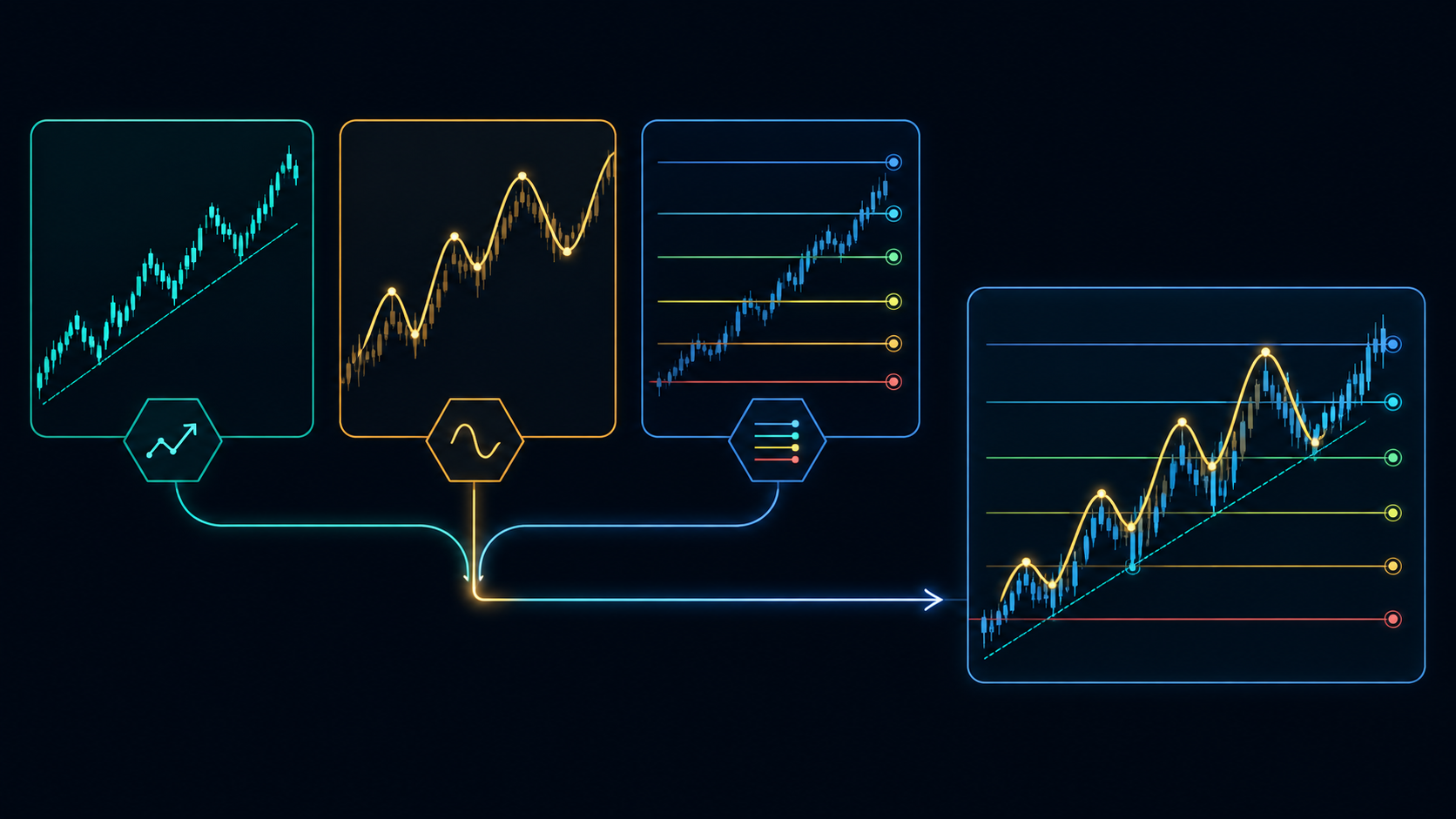
Most people think technical analysis is a single line or a single indicator. In reality, a reliable analysis comes from combining several methods that confirm one another. In this article, we explain the three core building blocks and why they're used together.
First pillar: Trend and price structure
Price doesn't move randomly, it advances by forming highs and lows. A series of higher highs and higher lows signals an uptrend, while lower highs and lower lows signal a downtrend. Reading trend structure answers the question "which direction is the market in right now," and it's the starting point of every analysis.
Second pillar: Elliott wave theory
Elliott wave theory holds that markets move in repeating wave patterns that reflect crowd psychology. A trend advances in five waves and corrects in three. This structure repeats itself on both small and large timeframes. Wave counting helps identify where price sits within this cycle, and therefore how much further a move might extend.
Third pillar: Fibonacci levels
Fibonacci retracement and extension levels are mathematical ratios that show where a move might pause or complete. Levels like 0.382, 0.5, and 0.618, when combined with wave structure, help clarify likely target and reversal zones.
Why use all three together?
Trend analysis alone gives direction but no target. Elliott wave alone shows structure but no precise level. Fibonacci alone gives a level but doesn't explain why it matters. Together, they form a complete scenario that includes direction, structure, and level.
At TraderLex, we prepare every analysis using all three methods together, layered with macro data. Our goal isn't to win a single trade, it's to build the habit of sound decision-making over time by providing a target, an entry level, and an invalidation point together.
Frequently Asked Questions
Does Elliott wave theory always work?
No, no method offers a guarantee. Wave counting is probability based, which is why it's always paired with an invalidation point.
Why do Fibonacci levels work so often?
Because a large number of market participants watch the same levels, which concentrates buying and selling activity around them.
Can a beginner learn all three methods on their own?
Over time, yes, but it takes practice. Following ready-made analyses to see how the method plays out in real time speeds up the learning curve.
This content is for informational purposes only and does not constitute investment advice.